History
Joseph A. Schumpeter in Graz
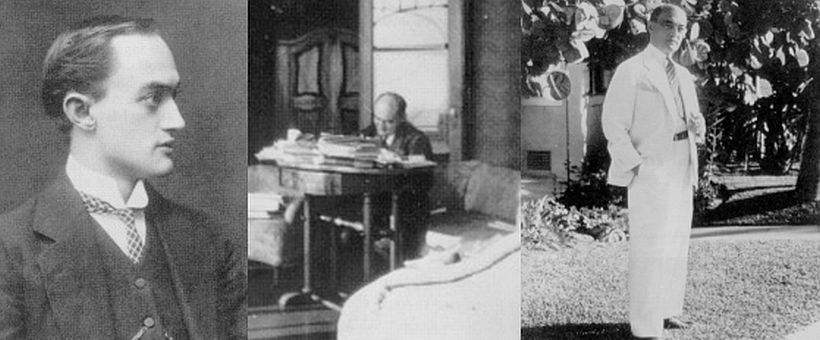
Joseph Schumpeter (1883-1950) was appointed full professor of Political Economy at the School of Law and Political Science of the Karl-Franzens-University in Graz by "Supreme Resolution" on 30 October 1911.
Schumpeter's period in Graz, which was formally supposed to last until 1922, with some interruptions, but actually ended in 1918, was marked by intensive teaching and research activities. In addition, Schumpeter held the office of dean during the academic year 1916/17.
As the only full professor in the field of economics, Schumpeter was responsible for completing an extensive teaching workload: in addition to his regular lectures on "Economics", "Economic Policy" and "Public Finance" (each lasting five hours per week), he also offered special lectures such as "Political Economy" and "Economic Democracy". In addition to his teaching activities at the university, Schumpeter also worked as an honorary lecturer in political economy at the former Technical University.
Since Schumpeter's main theoretical work, The Theory of Economic Development, was published in autumn 1911 (the imprint gives 1912 as the year of publication), it is impossible to prove a connection with the genius loci, even with the best will in the world. Nevertheless, Schumpeter presented a number of his most important works during his years in Graz. Particularly noteworthy are:
Epochs of Dogma and Method History (1914), a gem of theoretical historiography written for Max Weber's Outline of Social Economics, which reveals the posthumously published History of Economic Analysis in nuce;
Die Krise des Steuerstaates (The Crisis of the Tax State, published by Leuschner & Lubensky in 1918), a classic work of financial sociology; and the essays: "Das Grundprinzip der Verteilungstheorie" (The Basic Principle of Distribution Theory, 1916), "Das Sozialprodukt und die Rechenpfennige" (The National Product and the Calculating Pennies, 1917) and "Zur Soziologie der Imperialismen" (On the Sociology of Imperialism, 1919).
Schumpeter spent the 1913/14 academic year as an Austrian exchange professor at Columbia University in New York, from which he was also awarded an honorary doctorate at the age of 30.
It seems that Schumpeter's practical political ambitions were fuelled during the First World War. With this in mind, in 1916/17 he wrote several memoranda, circulated in private circles, in which he argued against the conclusion of a customs alliance or customs union with the German Empire and advocated the cause of the separate peace movement.
Schumpeter was an advisor to the "Socialisation Commission" set up by the Berlin government after the proclamation of the republic, before being appointed State Secretary for Finance of the Republic of German-Austria in March 1919 as a non-party member in a social democratic-Christian social cabinet led by State Chancellor Renner. After seven months in office, Schumpeter resigned, not least because of irreconcilable differences on the "Anschluss question".
In 1921, he took over the management of the Biedermann Bank in Vienna, which was to go bankrupt a few years later, causing Schumpeter considerable financial losses. In 1925, Schumpeter returned to academic life and accepted a position in Bonn as full professor of finance. Finally, in 1932, Schumpeter was appointed to the renowned Harvard University.
Text: Stephan Böhm